
Washington County Criminal Court Cases
Washington County criminal court records follow a clear local split. General Sessions Court deals with misdemeanor cases, warrants, initial appearances, and preliminary felony work. A felony that is bound over moves to Criminal Court. That division also hears indictments and presentments from the grand jury. The county places both divisions in the George P. Jaynes Justice Center, but each has its own suite and phone route. Criminal Court is in Suite 1212. General Sessions is in Suite 1210.
The case file, not the booking roster, answers what prosecutors filed and what the court decided. It can track a complaint or indictment, hearings, motions, plea, verdict, judgment, sentence, costs, bond events, and later appeal. The arresting agency may use a different charge at intake. For that reason, the local court file is the best source when an early arrest description and a final case outcome do not match.
Washington County's Two-Court Path
A Washington County misdemeanor may remain in General Sessions from its first setting through disposition. A felony often starts there for an initial proceeding and probable-cause work, then moves to Criminal Court after bind-over or grand-jury action. The county's official Criminal Court page confirms its felony and bound-over jurisdiction. The First Judicial District covers Carter, Johnson, Unicoi, and Washington Counties, yet each local file remains with the clerk for the county and division where it proceeded. A district office does not turn the four counties into one public docket.
Call the General Sessions state and criminal line at 423-788-1425 for lower-court matters. Call Criminal Court at 423-753-1612 for a felony docket or an upcoming Criminal Court case. Give the full name, an approximate year, and the case number when known. Ask staff to distinguish a Sessions number from a Criminal Court number. That small step can keep a search from stopping at the first stage of the same prosecution.
Searching Washington County Case Records
Washington County does not have one confirmed public portal that guarantees every trial file or document image. The county sitemap links to Search Court Records and Today's Court Docket, but the clerk's own phone and counter process remains the reliable path. Begin with the division tied to the charge stage. Ask for the docket or register of actions, charging instrument, disposition or judgment, and sentencing order. If the file is old or not digitized, ask whether staff can retrieve it for inspection.
- Identify General Sessions or Criminal Court from the case stage and charge level.
- Call the correct clerk line with the full name, approximate year, and known case number.
- Use the county's official court-record link as a starting point, then verify any result with the clerk.
- Request specific existing items, such as the register of actions, indictment, judgment, or sentence.
- Confirm current copy and certification costs before ordering because no verified fee schedule was located.
An online result may list a case without exposing the document needed. Screen text is useful for locating the file. A clerk-issued copy is the stronger choice when the wording of an order or the final disposition matters.
Washington County Appeals Search
Tennessee's Public Case History uses C-Track for the Supreme Court, Court of Appeals, and Court of Criminal Appeals. It does not search the Washington County General Sessions or Criminal Court trial docket. Use it only after a matter reaches an appellate court. A result can connect the appellate number to the originating county and trial number, which helps lead back to the local clerk's file.
| Search route | What to enter | Coverage note |
|---|---|---|
| Case number | Appellate case identifier | One of four search routes |
| Case style | Caption or party wording | Useful when the number is unknown |
| Party name | Name of an appellate party | Searches appeals, not county trials |
| Business or organization | Entity party name | Applies when an entity is in the appeal |
The official appellate search page shows why the state tool sits after the local clerk in the search order. The Tennessee Administrative Office of the Courts provides the source view below.
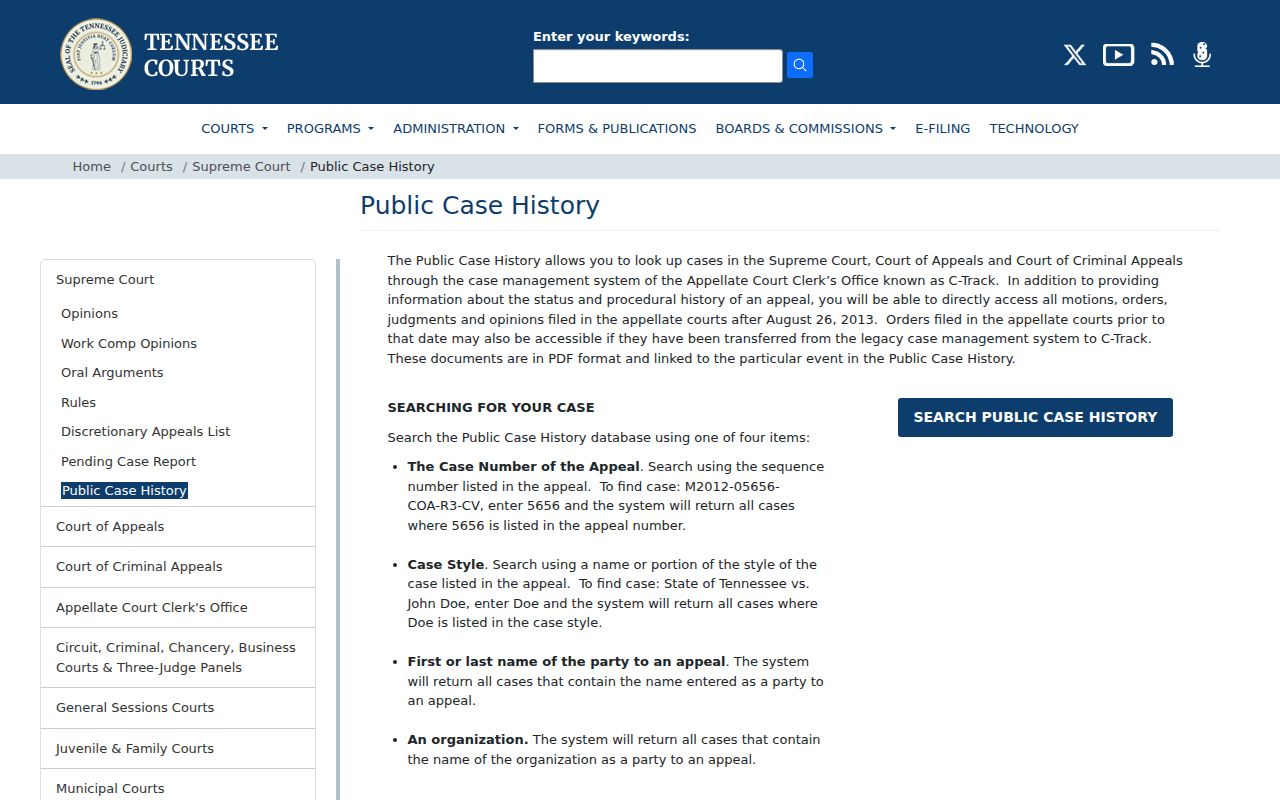
Its route choices can reveal appellate events and opinions, but the Washington County trial pleadings still come from the circuit court clerk.
Inside a Washington County Case File
A Washington County case file records the prosecution as it moves, rather than giving a short statewide summary. The docket can show when an item was filed and when a hearing occurred. The charging paper identifies the alleged offense. A judgment states the disposition, and a sentencing order gives the court's terms after a conviction. Bond, capias, attorney, costs, and appeal entries may appear as separate fields. Document images and protected personal data are not guaranteed online.
| Court and division | General Sessions or Criminal Court, which fixes the file's stage and custodian. |
|---|---|
| Case identity | Local case number, State of Tennessee caption, defendant, judge, and status. |
| Charge record | Charge, statute, class, complaint, indictment, or presentment date. |
| Docket activity | Filings, hearings, motions, plea or verdict, and attorney entries. |
| Outcome | Disposition, judgment, sentence, fines, costs, and related orders. |
| Custody process | Bond or capias events and any cross-reference to an appeal. |
Read those fields together. A status label alone may lag, while the signed judgment or dismissal order states the operative result.
Washington County Disposition Gaps
A local court disposition and a Tennessee repository entry are related, but they are not the same record. The clerk reports case outcomes for association with fingerprint-backed arrest cycles at the Tennessee Bureau of Investigation. TBI has documented that some dispositions are rejected when data cannot link them to an arrest. A Washington County case may therefore show a final outcome even while a state history still lacks it.
The TBI FlexCheck explanation supplies context for the repository process.
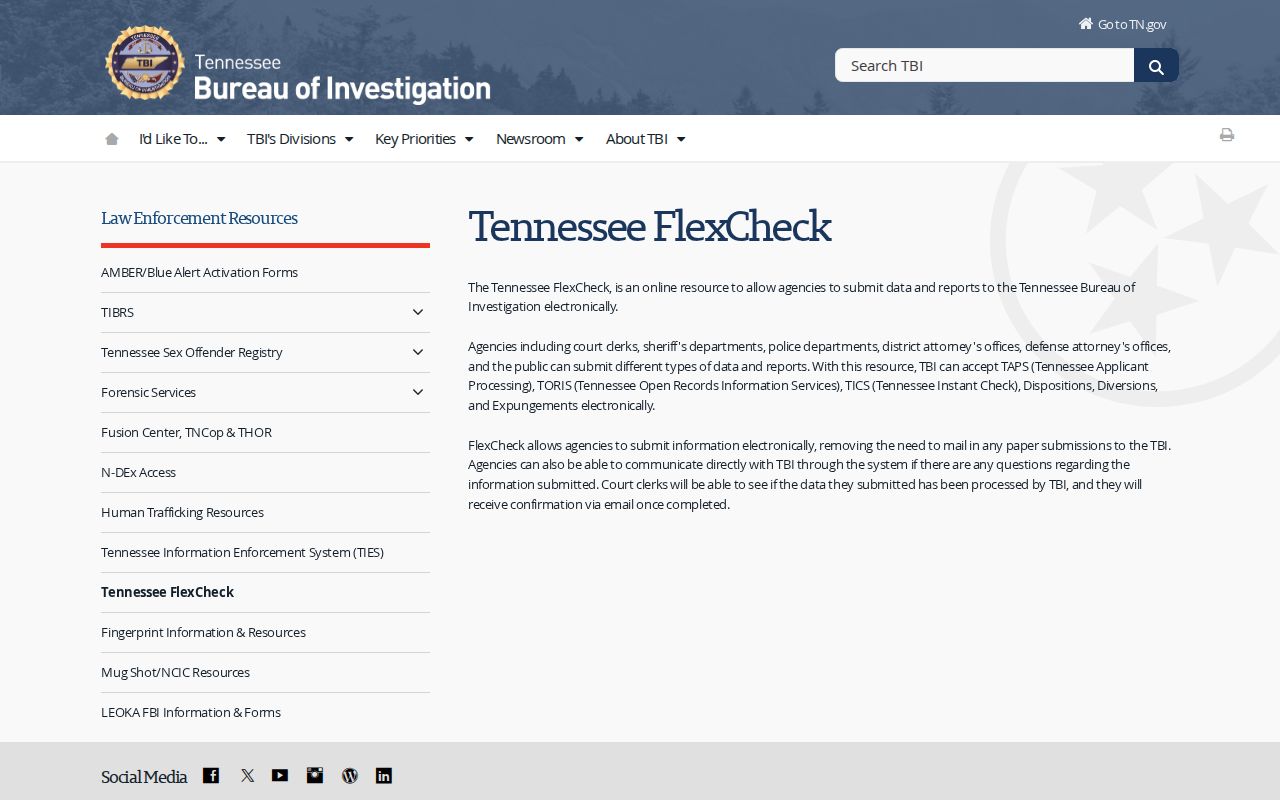
If a state result appears incomplete, obtain the Washington County judgment or certified disposition first. Then use the TBI correction or comparison channel rather than treating the screen result as the full case file.
How a Criminal Case Moves
Case stages explain why the same Washington County prosecution can have records in two trial divisions. A complaint, warrant, or arrest may lead to an initial setting in General Sessions. A felony can then be bound over for grand-jury review. An indictment is a formal accusation, not a finding of guilt. Criminal Court handles later pleas, motions, trial, judgment, and sentence. An appeal creates a separate appellate record without replacing the local trial file.
Case flow: Charges Filed → Arraignment → Pretrial → Plea or Trial → Disposition → Sentencing.
- Presentment
- A grand-jury-originated felony accusation.
- Nolle prosequi
- The prosecution's formal choice not to continue a charge at that time.
- Disposition
- The outcome of a charge or the whole case.
- Capias
- Court process directing that a person be taken into custody.
Each step can add a docket event or signed paper. Ask for the record tied to the question instead of relying on one status field.
Washington County Clerk Counter
The Circuit Court Clerk maintains Washington County trial files at the George P. Jaynes Justice Center, 108 West Jackson Boulevard, Jonesborough, Tennessee 37659. The official Justice Center directory lists weekday hours from 8:00 a.m. to 5:00 p.m. Criminal Court is in Suite 1212 and General Sessions is in Suite 1210. The county's criminal court page names judges Stacy L. Street and Lisa Rice, while the AOC clerk directory identifies Brenda Downes as circuit court clerk.
Circuit Court Clerk
George P. Jaynes Justice Center
108 W. Jackson Blvd.
Jonesborough, TN 37659
423-788-1412
Visitors enter through the front and pass a staffed metal detector. Phones, electronics, wallets, bags, and packages may go through x-ray. Bring only what is needed and allow time for screening. A person with a pacemaker or cochlear implant may ask for hand-wand screening.
Case Record Access & Restrictions
The Tennessee Public Records Act gives qualifying Tennessee citizens a route to existing open local records, but it does not erase confidentiality rules. Juvenile material, victim and minor identifiers, Social Security numbers, some investigative information, sealed process, and protected financial data may be withheld or redacted. Court clerks also apply rules specific to judicial records. A request should name an existing case or document and avoid asking the office to create a new case summary.
If the clerk cannot produce a file at once, ask whether it is archived, in another division, or subject to a written restriction. Washington County's County Attorney open-records process is a fallback for county department records, not a substitute for the clerk's trial-file procedure. Copy and certification prices were not verified in the official research, so confirm them before placing an order.
Washington County Sentence Records
A conviction judgment can lead to local sentence terms, probation, or Tennessee Department of Correction custody and supervision. The signed Washington County sentencing order is still the best source for what the judge imposed. TDOC's Felony Offender Information Lookup serves a different role. FOIL may show a TOMIS identifier, current status, location, active sentence, parole information, and release information after a felony enters the state system. The TDOC FOIL overview explains that statewide custody layer.
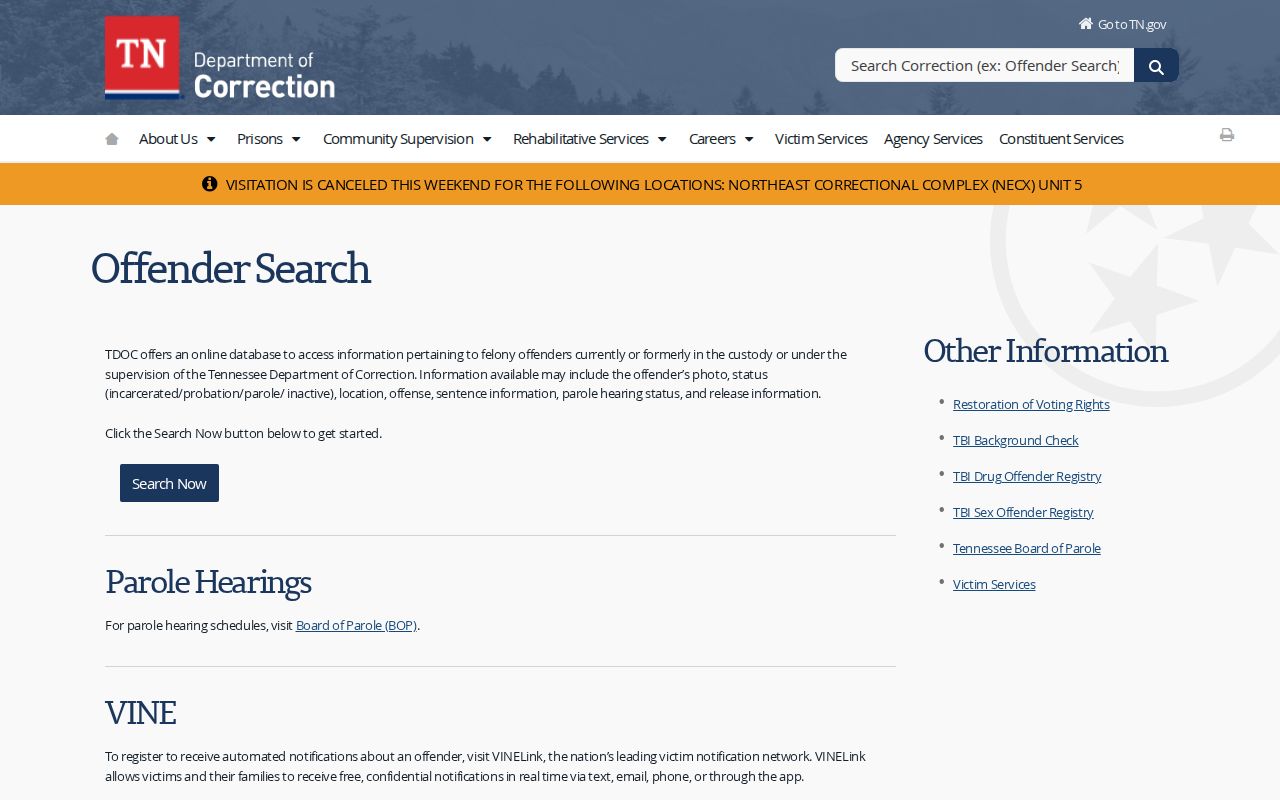
FOIL does not replace a Washington County misdemeanor file, motion, plea transcript, or judgment. It should be read after the local court record when the precise sentence controls. The official FOIL help page defines its state fields and limits.
That field guide helps decode later custody status, while the circuit court clerk remains the source for the underlying Washington County disposition.