
Checking Washington County Criminal History
No single Washington County search returns every official record. Begin with the event or case you know. The Circuit Court Clerk keeps General Sessions and Criminal Court files, while the Washington County Sheriff keeps its arrest, booking, detention, and warrant material. The Tennessee Bureau of Investigation maintains the statewide fingerprint-supported history. The Tennessee Department of Correction tracks felony custody and community supervision. Prepare the full name, an approximate date, the agency or court, and a case, report, or booking number when available.
Use the narrowest source first. That approach reduces false name matches and makes it easier to spot a missing disposition. A name-only repository result cannot supply the motions and orders in the local file. Likewise, a county docket does not report an unrelated Tennessee arrest from another county.
- Identify whether the starting record is a police report, booking, court case, warrant, or state history.
- Search the matching official portal or call the record custodian with a name and date range.
- Compare the arresting agency, court, charge, and dates before treating a result as a match.
- Pull the clerk's disposition or judgment when the final outcome matters.
- Order a certified court copy or official TBI self-review product when an ordinary screen is not enough.
Washington County's Four Record Stops
The clerk, jail, TBI, and TDOC provide four distinct views. The clerk answers what was filed and how the case ended. The county jail shows recent local custody. TORIS, also called TN-FlexCheck, searches Tennessee repository history. FOIL shows people currently or formerly in TDOC felony custody or supervision.
| Official source | Best question | Main limit |
|---|---|---|
| Circuit Court Clerk | What happened in this county case? | Local trial files only |
| WCSO detention records | Is the person in recent county custody? | Not the final case outcome |
| TBI TORIS | What Tennessee history is linked by submitted prints? | Name based and Tennessee only |
| TDOC FOIL | Is there felony custody, probation, or parole history? | Not every county charge |
Tennessee Official Background Checks
The Tennessee Open Records Information Services offers a public Tennessee name check for $29. It searches misdemeanor and felony arrests associated with fingerprint submissions within Tennessee. It does not include aliases, ordinary juvenile records, federal cases, or events from other states. The fee is nonrefundable, and a no-record response does not cancel the need to check a known Washington County file.
Tennessee Applicant Processing Services uses IdentoGO for statutory fingerprint programs. The requesting agency supplies the ORI or OCA code, and program fees vary. For personal review of a possible false name match, TBI accepts a $24 fingerprint comparison with a dispute letter and prints obtained from law enforcement. A subject who needs nationwide self-review can use the FBI electronic ordering portal.
The official TORIS screen shows the public request routes and payment notice.
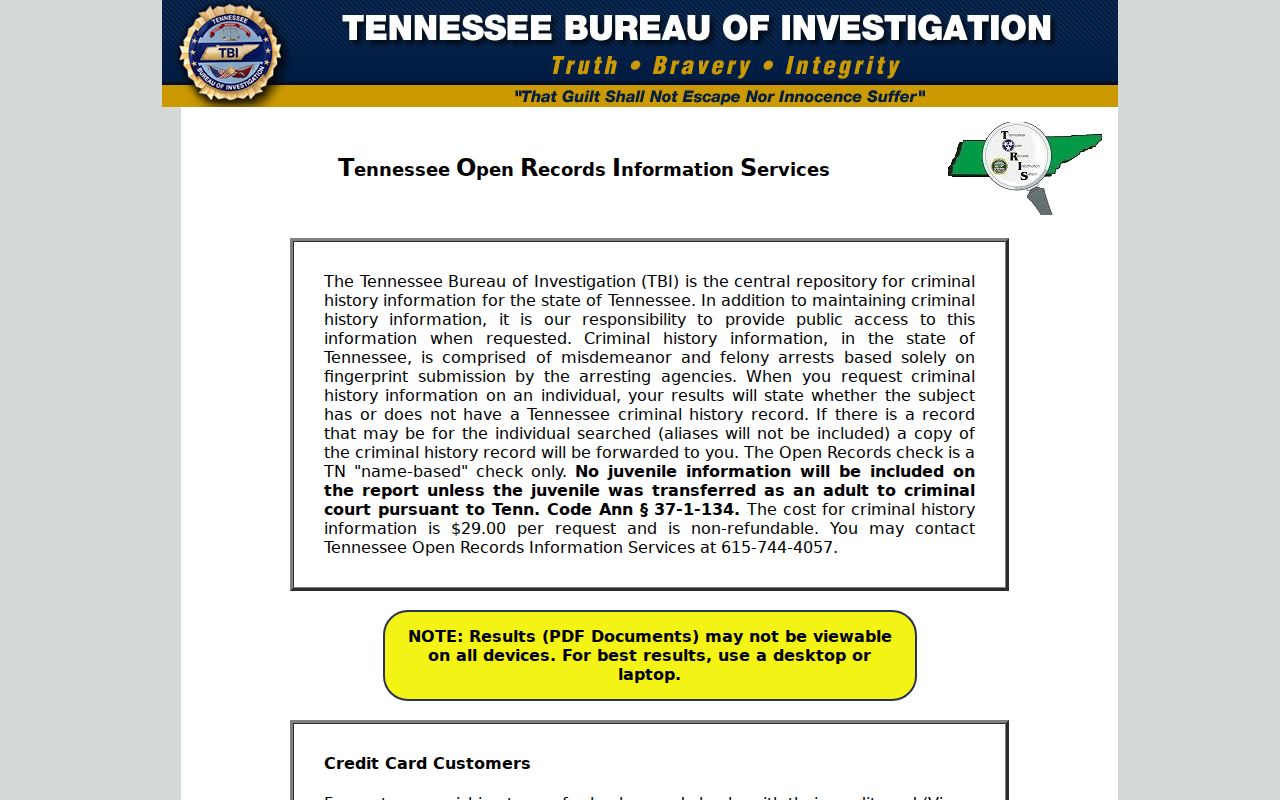
That state product is one layer of a Washington County review, not a substitute for a local judgment or certified case file.
TORIS Search Fields and Fees
TORIS first gathers requester contact information. Card users may continue with Visa, MasterCard, or Discover, while billable accounts use a separate login. TBI cautions that PDF results work best on a desktop or laptop. Exact subject fields appear after the payment route, so follow the live form instead of relying on an old screenshot.
| Item | Requirement | Detail |
|---|---|---|
| Online name check | $29 | Nonrefundable Tennessee search |
| Requester name and address | Required | Identifies the person ordering |
| Phone and confirmed email | Required | Used for contact and delivery |
| Fingerprint comparison | $24 | Challenge route for a disputed match |
Mail requests also cost $29. The application accepts checks, money orders, cashier's checks, and supported cards, but not cash or American Express. Results paid by personal check may be held for clearing.
Criminal Record Types
Washington County records follow the agency that made them. A police report records the event and investigation. A booking entry records intake and custody. The court file follows the prosecution. TBI then builds a fingerprint-associated Tennessee history from submitted arrest cycles and reported dispositions. Each record can be accurate while describing a different stage.
Warrants remain court process even when the sheriff serves them. Probation and parole data belongs to TDOC and the sentencing court. Registry information is maintained by TBI under a separate law and should not be read as a general rap sheet.
- Incident and arrest reports: held by the investigating sheriff, police, campus agency, or state patrol.
- Booking records: kept by the detention center and limited to custody facts and intake allegations.
- Court case files: held by the Circuit Court Clerk for Sessions and Criminal Court proceedings.
- Repository histories: maintained by TBI from fingerprint submissions and linkable outcomes.
- Custody and supervision files: split between the county jail, TDOC FOIL, and the sentencing court.
Washington County's Criminal Records Counter
The county's criminal court work is at the George P. Jaynes Justice Center, 108 West Jackson Boulevard in Jonesborough, not the historic courthouse on East Main Street. Criminal Court is in Suite 1212 and directs docket-status calls to 423-753-1612. General Sessions state and criminal matters use Suite 1210 and 423-788-1425. Circuit Court Clerk Brenda Downes maintains the local trial files.
Circuit Court Clerk
108 W. Jackson Blvd.
Jonesborough, TN 37659
423-788-1412
Monday through Friday, 8 a.m. to 5 p.m.
Washington County Sheriff
112 W. Jackson Blvd.
Jonesborough, TN 37659
423-788-1414
Detention Center
114 W. Jackson Blvd.
Jonesborough, TN 37659
423-753-1701
The county Criminal Court page identifies the felony jurisdiction and contact.
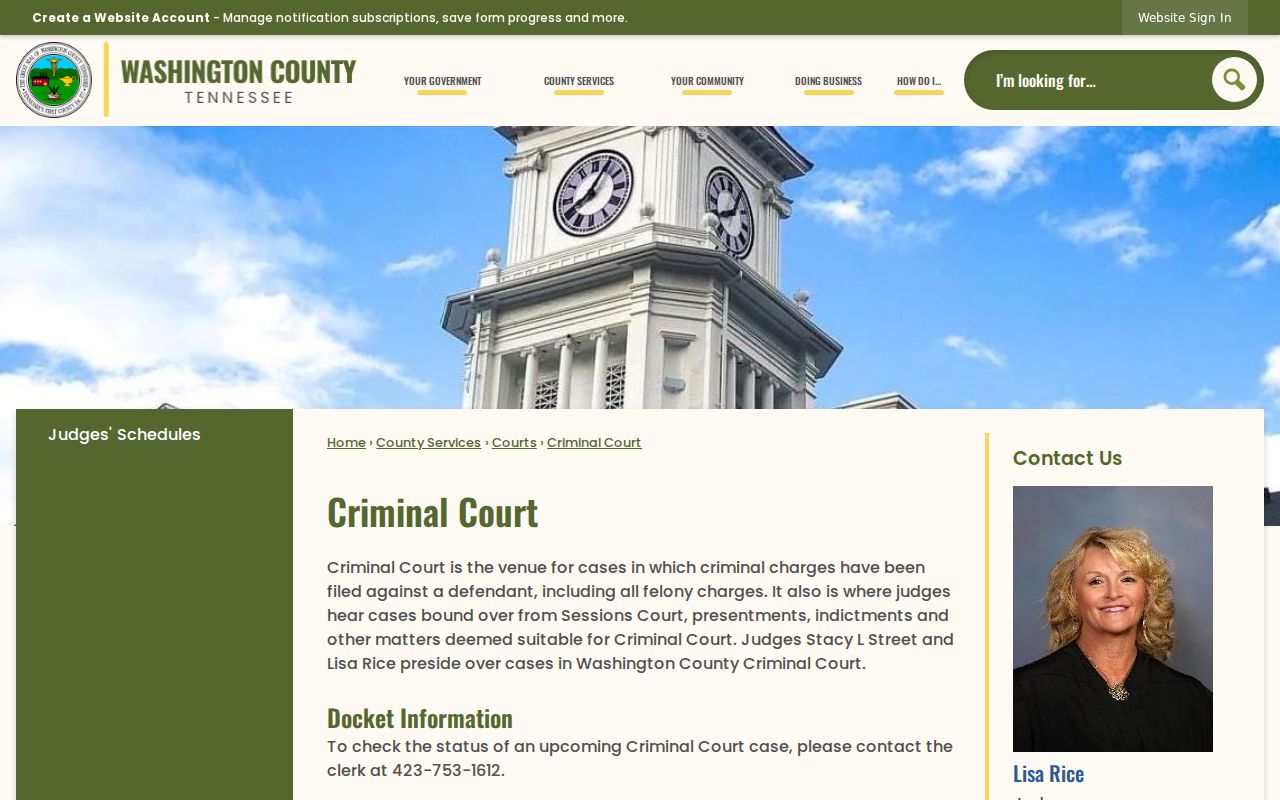
Call the correct division before a visit, especially for an older file that may need retrieval.
Inside a Washington County Criminal Record
The fields depend on the source. A court file can show the local number, charge, filings, hearings, plea or verdict, judgment, sentence, costs, bond entries, attorneys, and an appeal reference. A booking screen focuses on identity, intake, holding agency, dates, holds, and release. FOIL adds its eight-digit TOMIS identifier and felony custody or supervision information.
| Name and identifiers | Names, descriptors, agency identifiers, or a TOMIS ID where that system uses them |
|---|---|
| Arrest and booking | Arrest date, holding agency, intake time, initial charges, bond, and release status |
| Charges and statutes | Alleged offense, Tennessee citation, and charge class as recorded at that stage |
| Disposition | The outcome for each charge, such as dismissal, conviction, acquittal, or nolle prosequi |
| Sentence | The judgment, confinement, probation, restitution, costs, and court conditions when public |
| Custody or supervision | County custody, TDOC status, facility, probation, parole, or inactive status |
Washington County Warrants and Custody
WCSO provides a public warrant search by criteria such as name, charge, race, sex, issue date, and bond amount. The screen does not promise a case number, warrant number, judge, or service status. Confirm an apparent match with WCSO and the issuing court. A bench warrant or capias may arise from failure to appear, while a search warrant is not an arrest lookup.
For recent detention, use the county inmate portal. After transfer to state prison, switch to TDOC FOIL. VINE supplies custody notifications but is not a full criminal history. The sheriff's official WashingtonCo TN Sheriff app offers tips and agency information through its iOS listing and Android listing. Research found no app-only warrant or inmate tool.
The official FOIL interface illustrates the statewide felony layer.
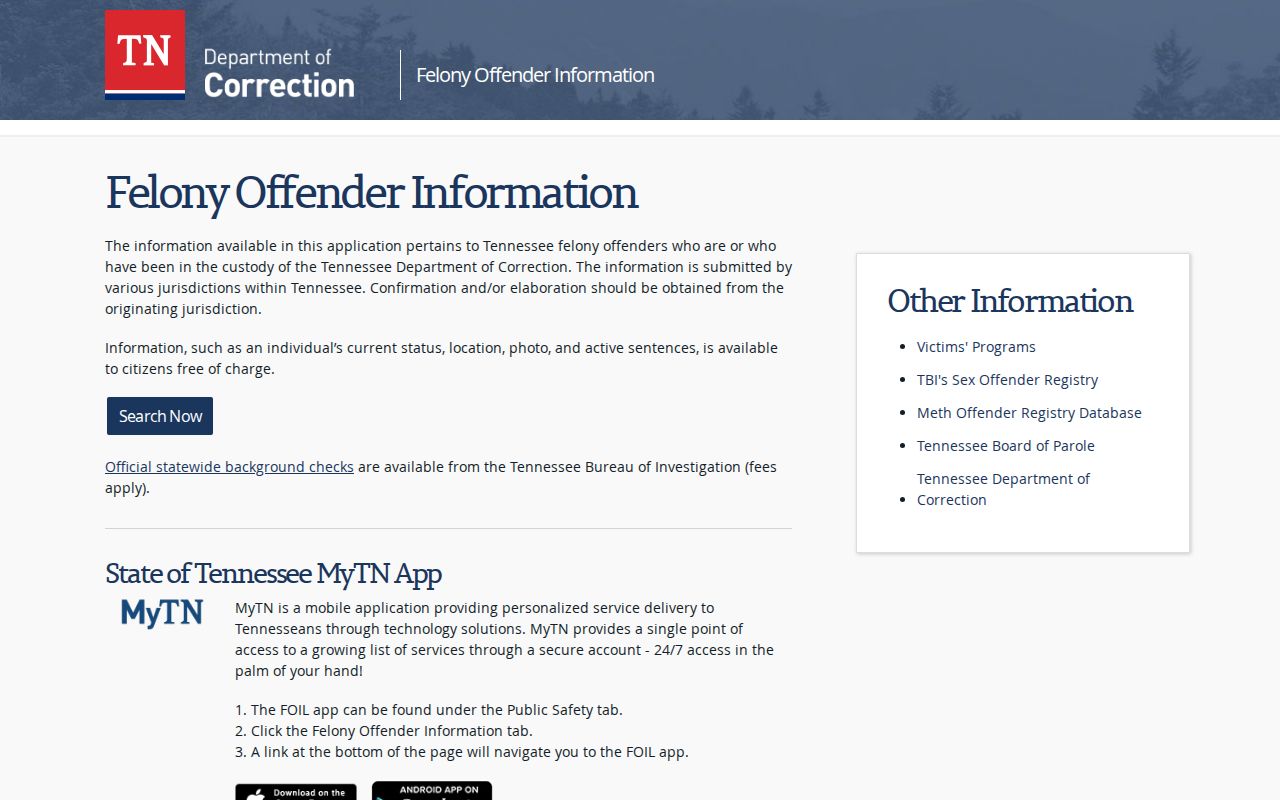
Read status, location, sentence, and release fields together before drawing a conclusion.
Public Access Laws in Tennessee
The Tennessee Public Records Act allows qualifying Tennessee citizens to inspect existing open records, subject to exemptions. It does not require an office to answer questions or create a new background summary. Court access also follows judicial rules, while TBI products operate under repository law. Ask for a named record, date range, agency, and identifier, and expect protected victim, juvenile, security, and personal data to be withheld or redacted.
Key Tennessee laws:
T.C.A. § 10-7-503 grants access to existing open public records for qualifying Tennessee citizens.
T.C.A. § 10-7-504 protects specified confidential information and permits required redaction.
T.C.A. § 38-6-120 governs TBI criminal-history checks and authorized fees.
T.C.A. § 40-32-101 controls qualifying expungement routes.
T.C.A. § 40-39-201 et seq. governs registry publication, verification, duration, and use.
Washington County's TPRA Fallback
When no special portal supplies the record, Washington County routes departmental requests through the County Attorney's Office. Use County Form 1 and specify inspection or copies. The form asks about Tennessee citizenship, contact details, the record description, delivery choice, and whether the requester waives an estimate up to a chosen amount.
Inspection is free. Standard letter or legal copies cost $0.15 per black-and-white page and $0.50 per color page. Labor may be charged after the first hour, and payment is required in advance when an estimate exceeds $250. If prompt production is not practical, the county sends a response within seven business days that explains the delay and estimates production. That is a response deadline, not a promise that every record arrives within seven days.
Route police reports to the investigating agency first and court pleadings to the clerk. The county process is the fallback for existing WCSO or departmental records, not a way to make the county compile a custom history.
Sealed, Expunged, and Restricted Records
Ordinary juvenile material is excluded from a TORIS open-records report unless the youth was transferred for adult prosecution. Active investigative details, victim and minor identifiers, social security numbers, financial data, sealed warrants, and expunged charges may also be restricted. A blank public result can therefore reflect a legal limit rather than the absence of every underlying event.
Washington County expungement begins with the clerk division that handled the case. TBI describes no-cost routes for qualifying dismissals, nolle prosequi outcomes, no true bills, and not-guilty results. Diversions can carry clerk fees. Limited convictions may qualify under T.C.A. § 40-32-101, but eligibility depends on the offense and history. The First Judicial District Attorney at 115 East Jackson Boulevard supplies the conviction packet route.
After the judge signs an order, the court distributes it to listed agencies. Keep a certified copy. If an entry remains, confirm that TBI, TDOC, and other custodians received the order instead of assuming the database will update at once.
Washington County Records Reach TBI
An arresting agency creates the report. At booking, the custodial agency records identity and charges, takes fingerprints, and submits a transaction control number. TBI uses those prints to associate the event with an identity. The court later reports the disposition. If a disposition lacks enough data to link it to the arrest, the repository can show an arrest without its final outcome.
Arrest → Booking and fingerprints → Charging decision → Court disposition → TBI linkage.
- Disposition
- The recorded outcome of a charge or case.
- Nolle prosequi
- The prosecution's formal choice not to continue a charge at that time.
- Capias
- Court process directing that a person be taken into custody.
- TOMIS ID
- TDOC's eight-digit offender identifier.
The AOC clerk directory confirms the local trial clerk responsible for the county case file.
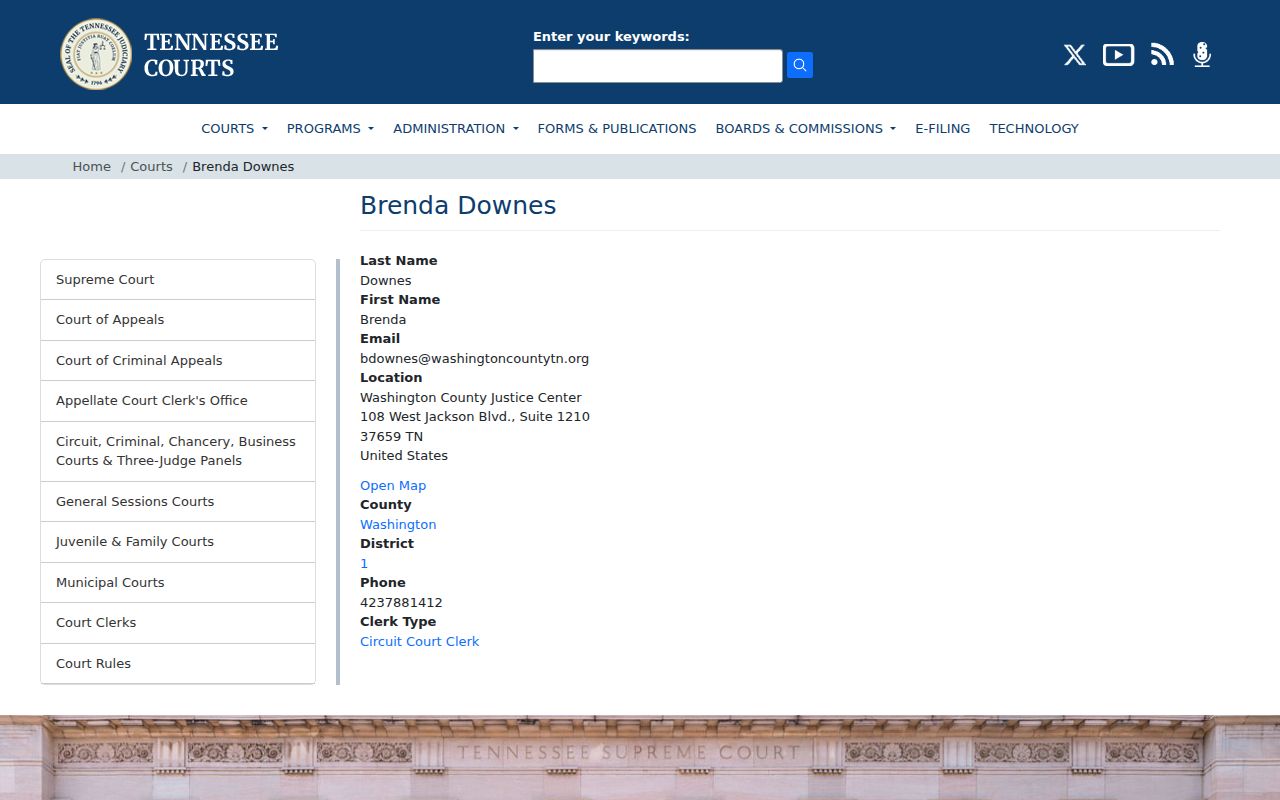
A certified local disposition is often the strongest evidence when a TORIS entry appears incomplete.
Washington County Registry Records
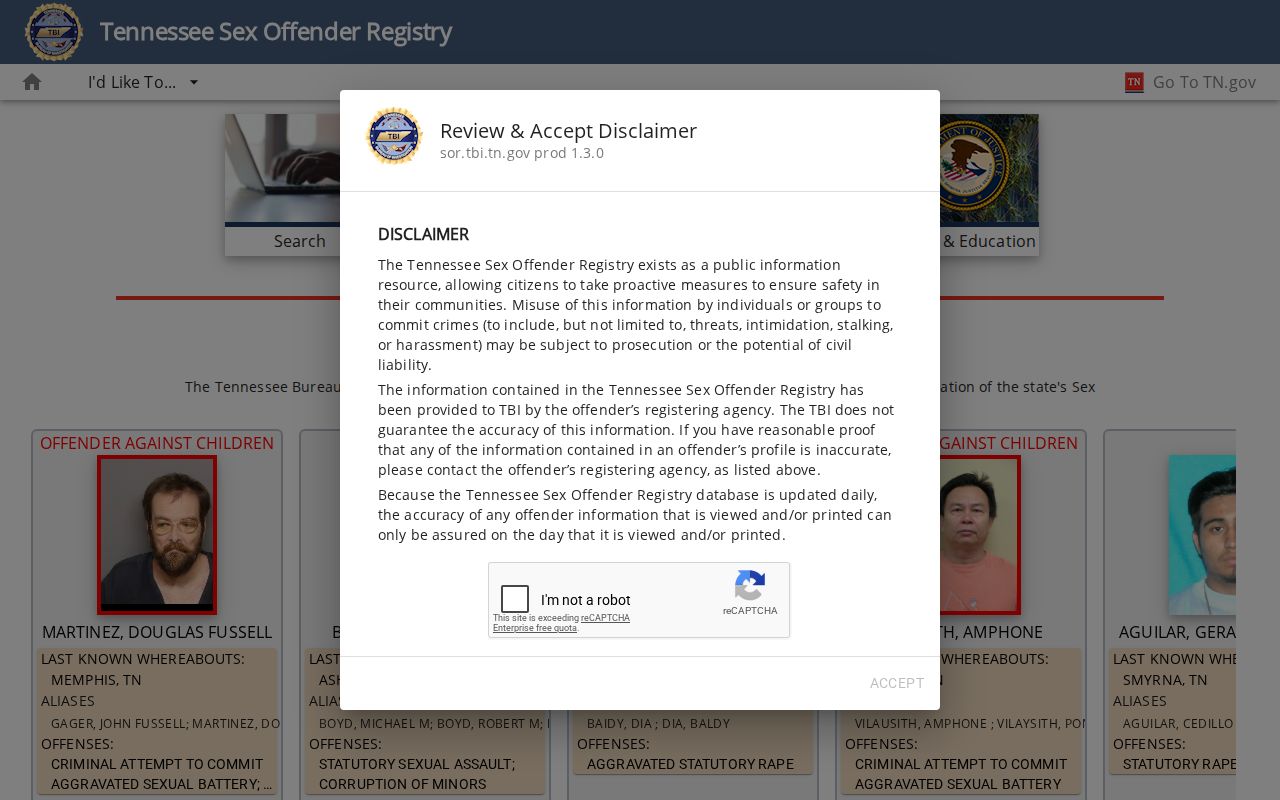
The Tennessee Sex Offender Registry is a statewide TBI system, with Washington County used as a filter. It is not a county-run list and not a general conviction search. Search by a known name or a complete local address, then read classification, status, last report date, and address fields with care. Near the Virginia line, the U.S. Department of Justice NSOPW search adds the official cross-state layer.
The Washington County sex offender search explains the portal fields, state categories, duration rules, and lawful-use limits in depth.
The TBI registry interface is the controlling Tennessee source.
Report suspected noncompliance to TBI or WCSO. Never investigate through confrontation.
Washington County Criminal Records by City
City police keep their own incident reports, and municipal courts handle local ordinance or citation matters within their authority. Johnson City and Watauga cross county lines, so the event location and booking county matter more than the city name alone. Jonesborough has a distinct town records counter even though county justice offices are nearby.
Johnson City Criminal Records
74,943 estimated in 2025 · City police reports, a city court desk, and cross-county booking routes
Jonesborough Criminal Records
6,990 estimated in 2025 · Town Hall report access and county court routing
Watauga Criminal Records
364 at the 2020 Census · Agency-first searches across the Washington and Carter boundary
Washington County Trial Search Limits
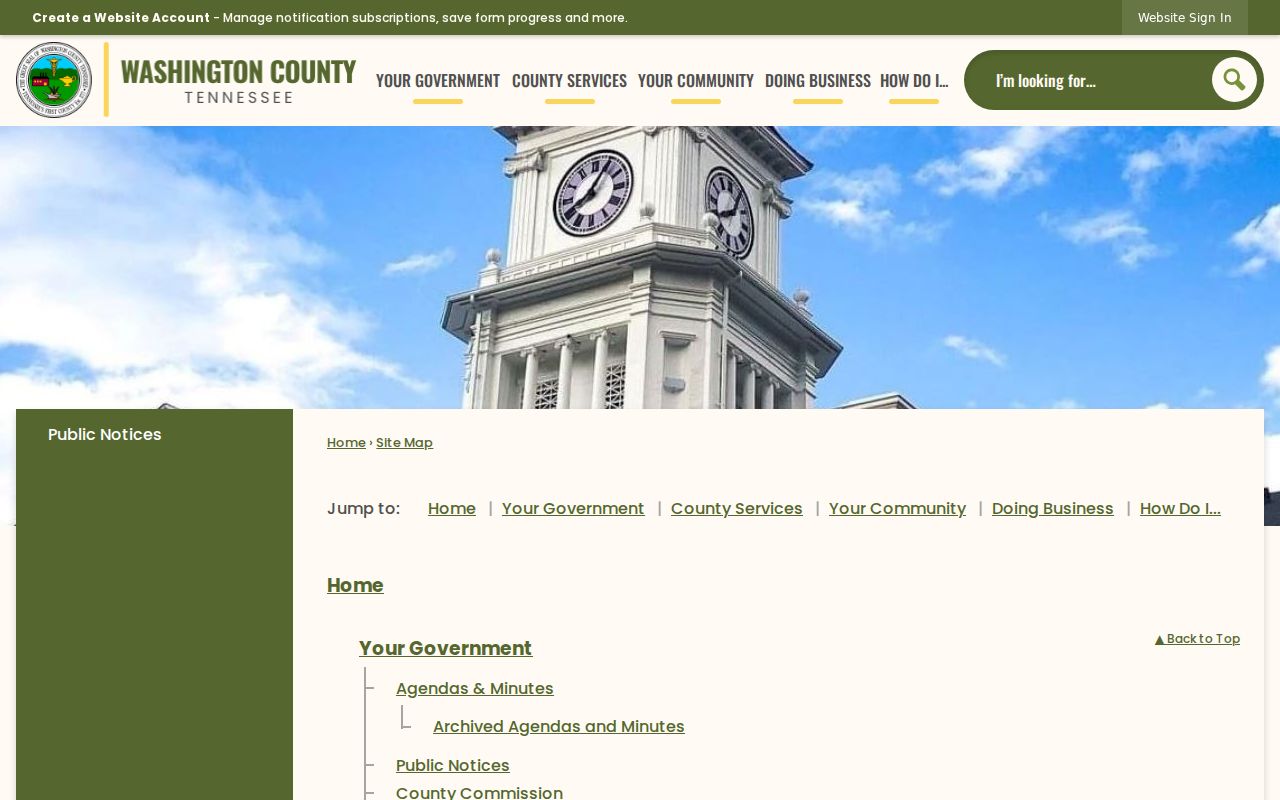
Tennessee has no single public statewide trial-court search. The AOC Public Case History system covers appeals, not the Washington County trial docket. The county provides court navigation and a linked case portal, but the clerk's phone and counter remain the authoritative fallback for a missing document, an old file, or a certified copy.
The county court navigation points readers toward court record and docket functions.
Use the full name, approximate year, and case number when known. Ask for the register of actions, charging document, disposition, and sentencing order rather than a vague background summary.